
Constructive Dissent Awards
In a democracy dissent is an act of faith. Like medicine, the test of its value is not in its taste, but in its effects.
- J. William Fulbright, U.S. politician (1905 - 1995)
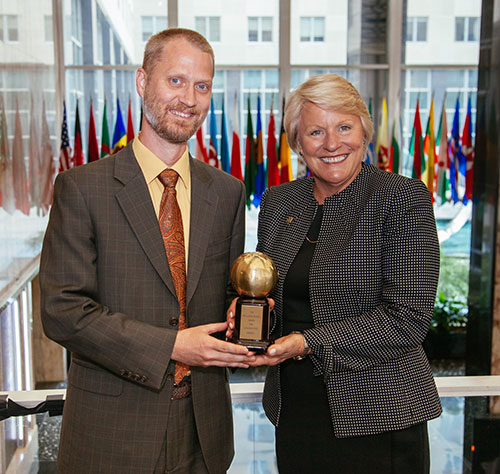
For close to half a century, AFSA has sponsored a program to recognize and encourage constructive dissent and risk-taking in the Foreign Service. This is unique within the U.S. Government. The Director General of the Foreign Service is a co-sponsor of the annual ceremony where the dissent awards are conferred. AFSA is proud to have upheld the tradition of constructive dissent for these many years, and we look forward to our ongoing role in recognizing those who have the courage to buck the system to stand up for their beliefs. Each year, AFSA calls for nominations of those who have had the courage to dissent within the system, and each October we give out these awards in a ceremony at the Department of State.
Recipients receive a trophy as well as a $4,000 cash prize.
Four awards are offered:
- The F. Allen “Tex” Harris Award for a Foreign Service Specialist.
- The W. Averell Harriman Award for an entry-level officer (FS 7-FS 4).
- The William R. Rivkin Award for a mid-level officer, (FS 3-FS 1).
- The Christian A. Herter Award for a member of the Senior Foreign Service (FE OC-FE CA).
AFSA collects nominations for our awards via Community Force. Nominations should be submitted through Community Force no later than April 13, 2026. The login credentials for this platform are separate from your AFSA account. Any questions can be directed to awards@afsa.org.
Criteria for the Dissent Awards
The awards are for Foreign Service employees who have “exhibited extraordinary accomplishment involving initiative, integrity, intellectual courage and constructive dissent”. The awards publicly recognize individuals who have demonstrated the intellectual courage to challenge the system from within, to question the status quo and take a stand, no matter the sensitivity of the issue or the consequences of their actions. The issue does not have to be related to foreign policy. It can involve a management issue, consular policy, or, in the case of the recently established F. Allen “Tex” Harris Award, the willingness of a Foreign Service Specialist to take an unpopular stand, to go out on a limb, or to stick his/her neck out in a way that involves some risk. Nominees may or may not have used the formal dissent channel. Click here to read more about what constitutes dissent.
Will Dissenting Hurt My Career?
Absolutely not. AFSA has honored dozens of dissenters through the decades, and we would be hard pressed to find one whose career was negatively affected as a result. In fact, many have gone on to long and successful careers in the Foreign Service. A list of past recipients includes such well-known officers as John W. Limbert, Ryan Crocker, Michael Guest, Jeffrey Feltman (former Under Secretary at the United Nations), Joel Ehrendreich (current Ambassador to Palau), Michael Gonzales (current Ambassador to Zambia), Douglas Silliman (former Ambassador to Iraq), Luis Moreno (former Ambassador to Jamaica), Daniel Russel (former Assistant Secretary for East Asian and Pacific Affairs), Eric Rubin (former AFSA President), Frontis Wiggins (former Chief Information Officer at the Department of State) and Geoffrey Pyatt (current Assistant Secretary of State for Energy Resources). For more details on any career implications from dissent, please see Shawn Dorman's September 2013 article on the amazing careers of some of our previous winners, or Francesca Kelly's January 2010 piece from the Foreign Service Journal, "Does Dissent Harm Your Career?"
Nomination Procedures
Nominations for the 2025 awards should be submitted through the AFSA website no later than Monday, April 7, 2025. Any questions can be directed to AFSA's Programs and Member Engagement department. They are available at member@afsa.org.
Nominations
The nomination must include the following elements:
- Nominee’s name, grade, agency and position.
- Nominator’s name, grade, agency and position and description of association with the nominee.
- Justification for nomination. The narrative should discuss the actions and qualities that qualify the nominee for the award, with specific examples of accomplishments that fulfill the criteria above. The narrative should not exceed 700 words.
Additional Guidelines for Nominations
- Only career or career conditional Foreign Service members of the foreign affairs agencies are eligible to be nominated for an award: i.e. State, USAID, FCS, FAS, APHIS or USAGM employees.
- Self-nominations are not accepted for constructive dissent awards.
- Group nominations are accepted.
- A person may be nominated more than once in different years for the same award, provided that he/she has never won for the same achievement/circumstance.
- The time period during which the actions attributed to the nominee took place does not have to be within the most recent calendar year. However, they should have occurred not more than four years from the time of the nomination.
- Nominations for all AFSA awards should go directly to AFSA.
- Since the purpose of the Dissent Awards is to encourage Foreign Service employees to speak out honestly and frankly, non-career ambassadors and other political appointees are not eligible for nomination.
- Current AFSA Board members may not be nominated for activities while serving on the Board, but may be nominated after they leave the Board for the Board and other relevant contributions.
- Nominations for any of the awards may be submitted by anyone with knowledge of the nominee’s accomplishments except their spouse, partner, or significant other, and the nominee does not necessarily need to be a current government employee. As noted in part 2 of the nomination guidelines, the nominator must describe the relationship or association with the nominee.
- The Awards and Plaque Committee has final authority over decisions by all judging panels to ensure consistent standards.
Note: The State Department's Dissent Channel and USAID's Direct Channel are unrelated to AFSA's dissent awards. We welcome any discussion and encouragement of dissent within the foreign affairs agencies, but messages sent through these channels will not necessarily come to AFSA's attention unless cited in a nomination.